Field Notes
The Founders Who Don't Count

Britain's new tax relief for founders has been called a sleight of hand. Checked against the evidence, it looks more like a reasonable idea with some fixable drafting.
When the Budget announced Founders' Relief on 28 October, the verdict in my feeds was in within about an hour, and I expected to agree with it. A 10% rate of Capital Gains Tax on up to £10 million of gains, for founders of high-growth companies, wrapped, the argument went, in conditions so tight that hardly anyone would qualify. Meanwhile the older relief that ordinary business owners actually use was being cut in half. It looked, to plenty of people, like a giveaway with the price tag hidden on the back.
The conditions are certainly tight. The founder must have held 25% of the shares when the trade began. The company needs £10 million of turnover and fifteen qualifying full-time employees in the year before the sale, must still be doing what it was set up to do, and must pass two of three tests: 25% annual growth in turnover from a £10 million base, the same growth in headcount from fifteen, or £1.5 million of research spend with the tax relief claimed. A qualifying employee works at least 35 hours a week and is not a director, which produces my favourite detail in the whole document. The founders the relief is named after do not count as employees of the company they founded.
So let's take a look at the claims I have seen in the last 24 hours, and check them against the evidence.
The bits that fell over
"Hardly anyone will qualify"
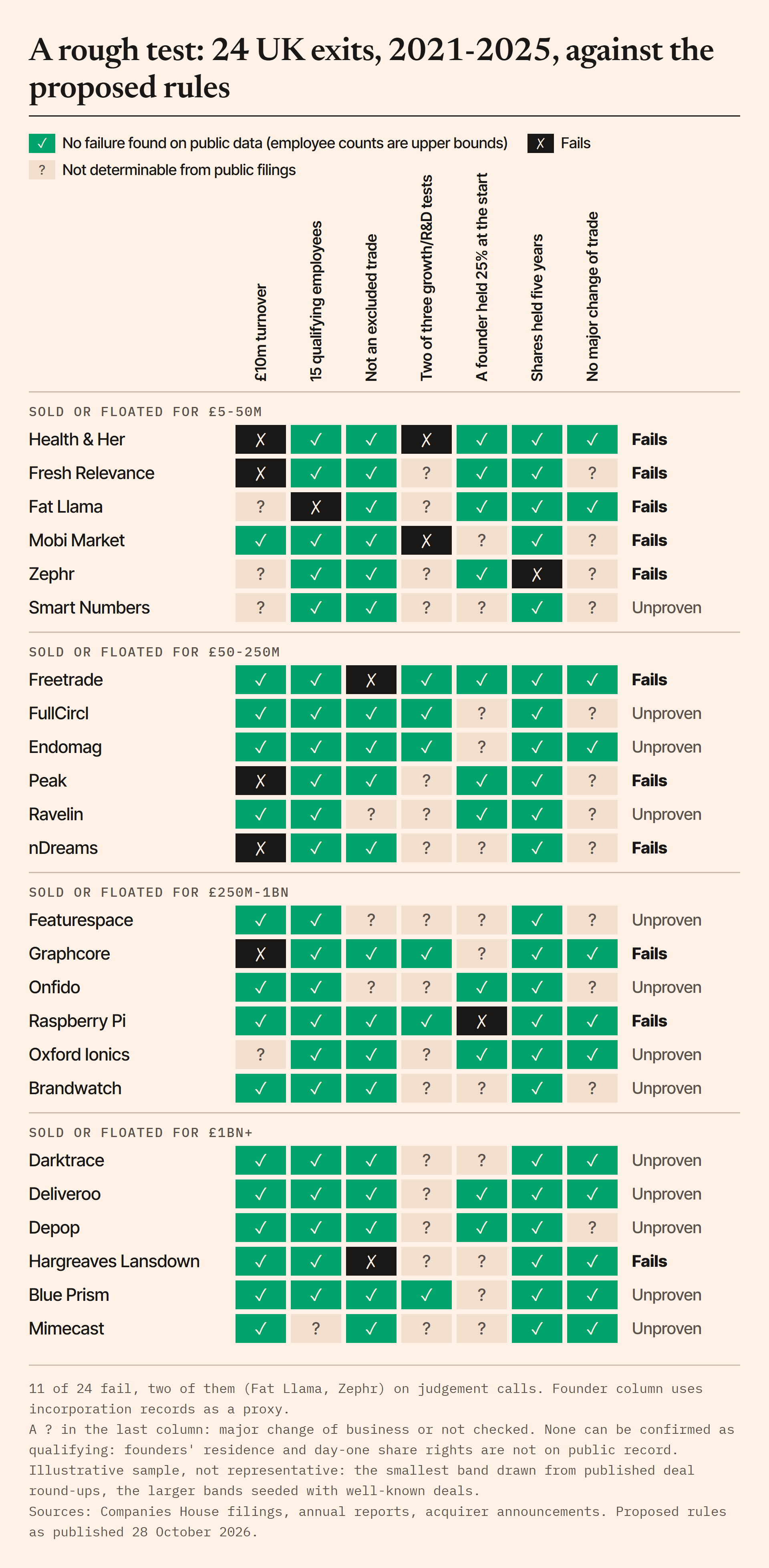
This went first. The Treasury expects about 600 people a year to be eligible, from around 400 businesses. That is a small club, and it is the club the Treasury says it is building. To see whether the doors were painted on, I tested 24 UK companies sold or floated between 2021 and 2025, from a menopause supplements brand sold for under £10 million to Darktrace, against the proposed rules using their filed accounts. Several of the larger ones, Endomag and Blue Prism among them, pass every company test the public record can show.
"It's a cut dressed as a giveaway"
The Treasury's costings show the cut to Business Asset Disposal Relief raising £1,080 million over five years and Founders' Relief costing £1,285 million. Together they cost £205 million. You cannot call that a saving with a straight face.
"It shuts out the lean company"
This was the argument I found most persuasive. A lean company, say £20 million of turnover with a handful of engineers and a great deal of automation, fails the fifteen-employee rule even if it passes everything else, and the economy we keep being promised is full of companies like that. In the sample of 24, exactly one company failed on headcount, and even that one is doubtful because some of its staff may have sat in a sister company. The companies that failed mostly failed on turnover, and some of them had payrolls the size of a decent comprehensive. Graphcore, reported to have sold for about £400 million, employed more than 400 people and turned over about £3 million in its last year. The lean company exists, and it is rare.
The one that changed my mind
"A lower rate will encourage founders"
This is the point that undid the rest, and I had not seen anyone question it. The relief this one partly replaces, Entrepreneurs' Relief, was studied. HMRC's own survey found that only 16% of claimants knew about it when they invested, and about half of those said it made no difference. The Resolution Foundation put its cost at £22 billion over ten years, with 12% of claimants taking 69% of the gains relieved. Most claimants, on that evidence, would have invested the same way without it.
If that holds for the new relief too, it will not change many decisions, and the argument for widening it on incentive grounds is an argument for more of something that does little. What the relief does do is decide whose success the state formally rewards, at a cost of £1.3 billion over five years. That is a smaller question than the one I started with, and a more useful one.
The bits that stuck
Quite a lot, as it turns out, though none of it is a scandal.
The papers disagree on who counts as an employee
The consultation's company conditions ask for fifteen "full-time employees" of 35 hours or more. Its own headcount growth test, and the impact note, say "full-time equivalent". On the first reading, my imaginary lean company with four engineers on a 32-hour week has thirteen qualifying staff and fails. On the second it has nearly seventeen and passes. Whether a £20 million business qualifies for a £10 million relief currently depends on three hours a week for four engineers, and the consultation does not say which reading applies.
The 25% test has a wobble
The consultation says a founder must "have held 25%", without the "at least" that appears in the costings, which on a literal reading excludes the founder who started with 40%. That is presumably a slip, and the cases that matter sit either side of it. A technical co-founder who joins six months in, after the first customers, can own a quarter of the company and still fail. So can five equal founders at 20% each.
The thresholds are cliff edges
Peak, an AI company with around 200 staff when UiPath bought it, missed £10 million of turnover by under a million. Mobi Market roughly tripled its turnover in three years, from £5.3 million to £15.5 million, and fails both growth tests because its sprint started below the £10 million line. The relief only counts growth that happens after a company is already large.
The money moves between owners
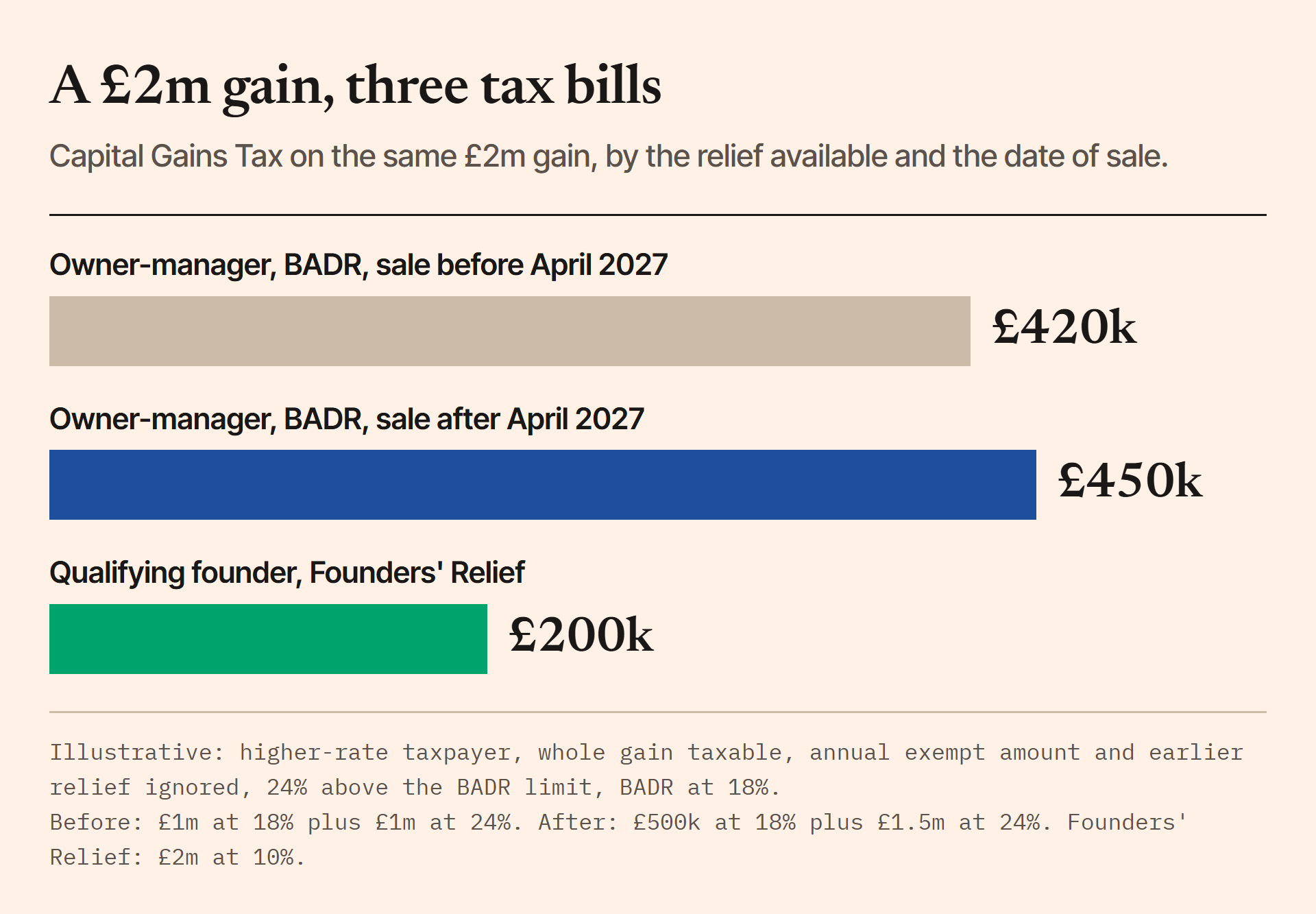
From the second year, the sum raised by cutting the older relief and the sum spent on the new one sit within £5 million of each other. Roughly the same amount comes off owner-managers with gains above £500,000 and goes to the 600. On a £2 million gain, an owner-manager selling after April 2027 pays about £450,000, up from £420,000. A founder who clears every test pays £200,000.
There is a trap after the sale
If HMRC later decides a condition was not met, the founder loses the relief and owes the tax with interest, on the affairs of a company they may no longer control and about which HMRC may not be allowed to tell them very much.
What I'd ask for
Tidy the definitions
The fixes are mostly tidying. One definition of a qualifying employee, used everywhere, with the counting method written down. A founding-team test for the 25%, so the second founder through the door is not excluded. Perhaps a payroll-cost threshold alongside the headcount, which is harder to clear by hiring two people in the final year. And if wider gates cost more, a lower lifetime allowance to pay for them. None of that is costed here, and a tax adviser would have views on all of it.
Publish the list
The most useful request costs the Treasury a spreadsheet. It should publish the exits behind its estimate of 600 eligible people a year and how many of them clear each test. My 24 took a morning and prove very little on their own. The Treasury's version would settle most of the arguments in this piece, including the ones a sample of 24 cannot.
Why I am hopeful
All of this leaves me more hopeful than I expected to be. The Treasury has built a narrow relief, costed it in the open and asked what it has missed. What it has missed is mostly drafting, and drafting is what a consultation is for. It closes on 30 November, and founders with real numbers should answer it.
This piece examines proposals published on 28 October 2026, which remain subject to consultation. The lean company and the £2m gain are illustrations. The 24-company test is an illustrative sample, not a representative one, and public records cannot confirm that any individual founder qualifies. Sources: HM Treasury technical consultation and Budget 2026 policy costings; Founders' Relief tax information and impact note; HMRC Research Report 456 (2017); Resolution Foundation (August 2018); Companies House filings and acquirer announcements. None of this is tax advice.